Why the Zalo group category matters when submitting a link
When submitting a Zalo group link to a community directory, many admins focus on the group name, description, and invite link. However, the Zalo group category is just as important. The category is the first signal that helps readers understand what the group is about, which need it serves, and whether it is worth opening for more details. If you choose the wrong category, the group may appear in front of people who are not interested, while the people who actually need it may never find it.
For example, an accounting recruitment group should be placed under jobs rather than a general community category. An Excel learning group should belong to learning rather than technology if its main purpose is office skill training. An apartment residents group should be treated as a local or community group, not as a buying and selling group just because members occasionally resell used items. Choosing the right category gives the group better context and reduces wrong-fit joins.
- A category helps readers quickly understand the group’s topic before reading the full description.
- Choosing the right category helps the group reach more relevant people and reduces members joining with the wrong expectations.
The basic rule for choosing the right Zalo group category
The most important rule is to choose based on the main need of the people who join, not just the group name. A group named ‘Young Accountants Community’ may sound like a general community, but if the main content is job postings, the jobs category should come first. A group named ‘Shop Owner Circle’ may belong to retail, services, or business operations depending on whether the group is mainly for trading, operational Q&A, or customer support.
Before choosing a category, ask three questions. Why do people join this group? What type of content appears most often? If a stranger saw the group inside this category, would it feel logical? If the answer still feels mixed, choose the category that reflects the most stable and recurring content, not a few occasional posts.
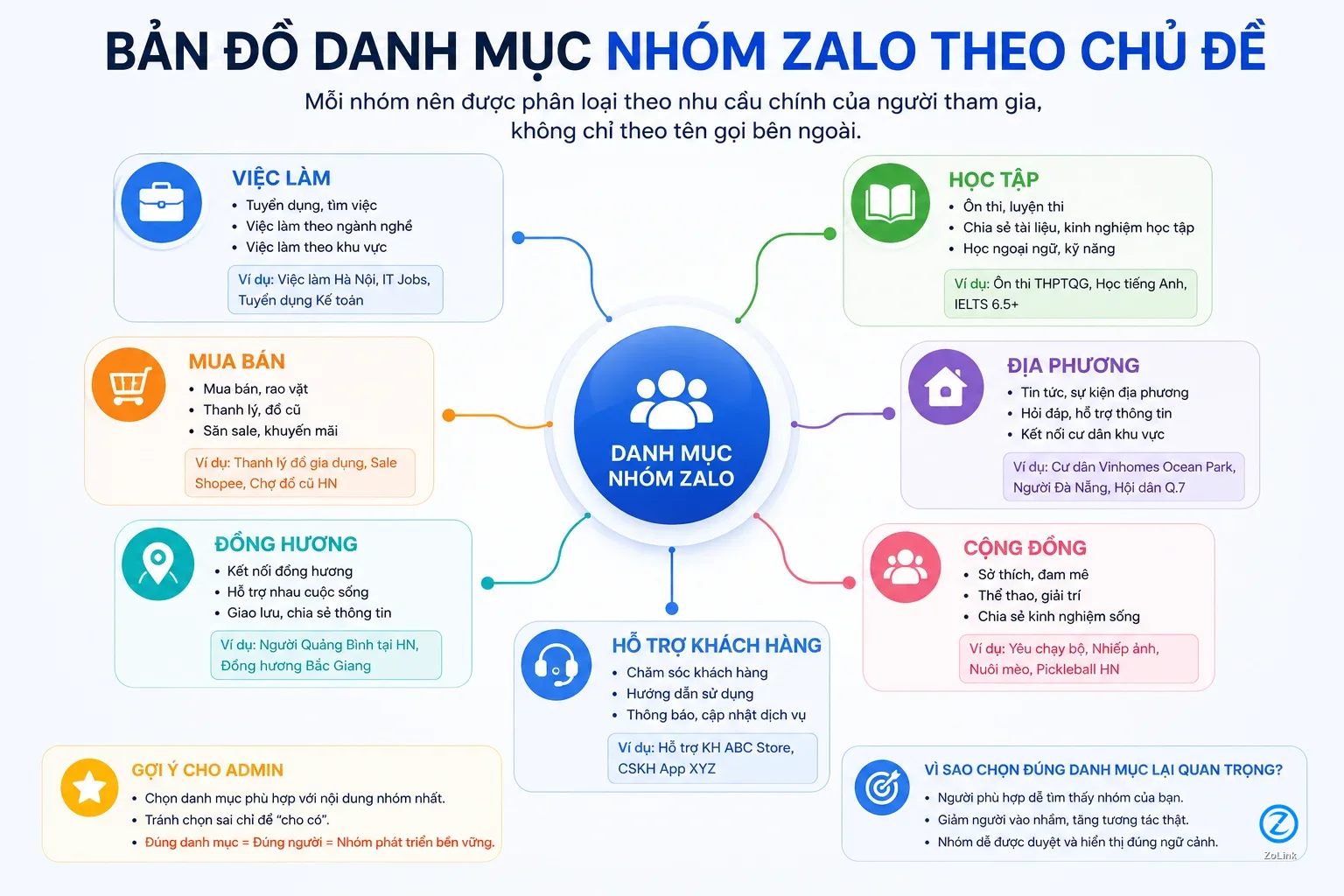
- Choose the category based on the group’s main need and the content that appears most often.
- Do not choose a category only because the group name sounds related to that topic.
Which category should job groups choose
If the group mainly shares recruitment posts, job openings, candidate searches, part-time work, collaborator opportunities, or labor market updates, the most suitable category is jobs. This applies to industry-based groups such as accounting, marketing, sales, IT, customer service, teachers, and collaborators, as well as location-based job groups for Hanoi, Ho Chi Minh City, Da Nang, or specific provinces.
When listing a job group, the description should state whether the group is for candidates or recruiters, what types of roles may be posted, which location is prioritized, and what content is not allowed. You can refer to how job-related groups are organized in the jobs category. If the group combines recruitment with career experience sharing, look at the main purpose before choosing the category.
- Groups for recruitment posts, job searches, part-time work, or career opportunities should prioritize the jobs category.
- A job group description should clearly mention the industry, location, target members, and allowed post types.
How to classify learning groups
Learning groups are suitable for communities that share documents, answer questions, prepare for exams, learn languages, practice office software, develop professional skills, or exchange self-study experience. If people mainly join the group to learn, ask questions, or receive study materials, the learning category is usually more accurate than technology, lifestyle, or general community.
Some groups may feel ambiguous. For example, a programming study group is related to technology, but if its focus is beginner lessons, troubleshooting basic errors, and sharing learning paths, learning is still a reasonable choice. Groups for IELTS materials, Excel, Japanese, design, or data analysis should also describe the level and support format clearly so learners know whether the group fits them.
- Groups for documents, Q&A, exam preparation, or skill learning should usually choose the learning category.
- If the group studies a technology-related topic but the main purpose is education, classify it by the learning purpose.
How buying and selling groups differ from service groups
Buying and selling groups usually revolve around specific products such as mother and baby items, home goods, fashion, cosmetics, phones, secondhand items, plants, or food. If the main content is selling, buying, reselling, exchanging products, or finding deals, the group should be placed under the relevant retail or product category. The description should mention the product type, transaction area, posting format, and prohibited content.
Service groups are different. If the group mainly connects people who need to hire someone with people who provide services such as repairs, delivery, design, consulting, beauty, tutoring, photography, or technical support, a services category is usually more accurate. Choosing incorrectly between products and services can mislead readers. Someone looking to buy an item has a different intent from someone looking to hire a service provider.
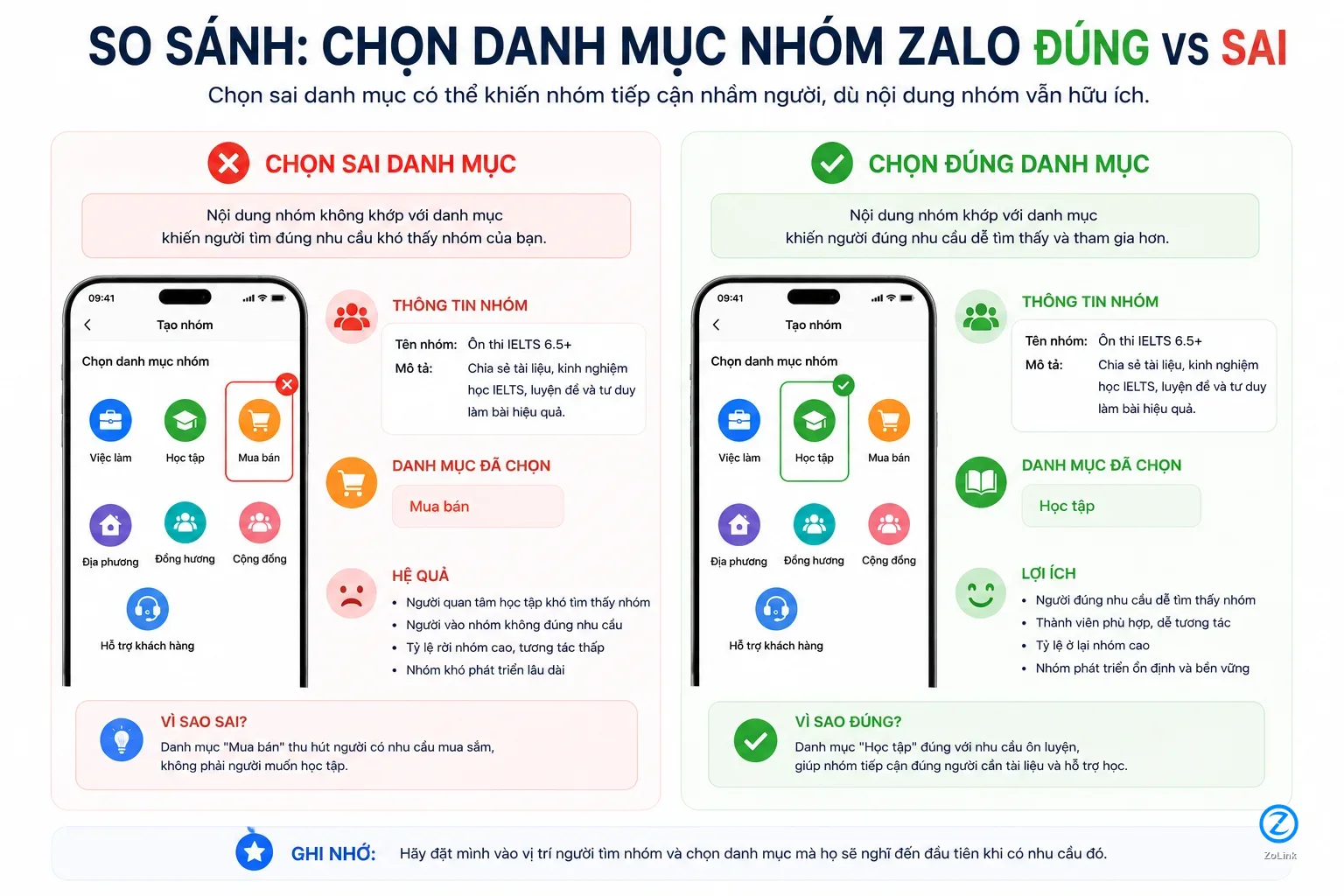
- Groups that sell, resell, or exchange physical products should be classified by the relevant product or retail category.
- Groups connecting customers with service providers should choose a services category.
How to choose categories for local hometown and community groups
Local groups usually revolve around a specific area such as an apartment building, ward, district, city, or province. Content may include daily-life Q&A, local utilities, safety alerts, lost and found posts, restaurant recommendations, small-scale buying and selling, or resident support. For this type of group, geography is the main reason people care, so the description should clearly state the area.
Hometown groups are also based on location, but their purpose is often to connect people from the same hometown who now live in different places. Examples include people from Nghe An living in Ho Chi Minh City or people from Quang Nam living in Japan. If the group focuses on networking, mutual support, hometown updates, and community connection, choose a category that reflects the community or local identity rather than buying and selling, even if some product posts appear occasionally.
- Local groups should state the area clearly because location is the most important filter for members.
- Hometown groups should be categorized by their community-connection purpose, not by a few isolated product posts.
Where should customer support groups be placed
Customer support groups are often created by shops, classes, projects, services, or product communities to share announcements, answer questions, and support people who are interested or have already purchased. These groups should not automatically be classified as buying and selling just because they are related to customers. If the main purpose is answering questions, usage guidance, class updates, warranty support, or after-sales care, a service or product-related category may be more suitable depending on the nature of what is being supported.
When submitting a customer support group link, the description should clearly state who should join. For example, it may be for existing customers, enrolled students, current product users, or people considering a purchase. If the group does not handle private complaints publicly or does not allow cross-promotion, say so briefly. The right category is only the first step; a clear description is what prevents people from joining with the wrong expectation.
- Customer support groups should be categorized by the nature of the product or service being supported.
- The description should clarify whether the group is for buyers, students, current users, or interested prospects.
Common mistakes when choosing a Zalo group category
The first mistake is choosing a category that is too broad in the hope of reaching more people. For example, a Japanese learning group may choose entertainment because the category seems to get more views, or a recruitment group may choose general community to avoid feeling too narrow. This usually does not work well, because people who see the group in the wrong context will ignore it, while the right people will have a harder time finding it.
The second mistake is choosing based on secondary content instead of the main content. A residents group with a few used-item posts does not necessarily belong in a product category. A shop-owner group with occasional hiring posts does not need to switch to jobs if most of the content is still about business operations. When classifying a Zalo group, look at the long-term purpose and the content type that appears most frequently.
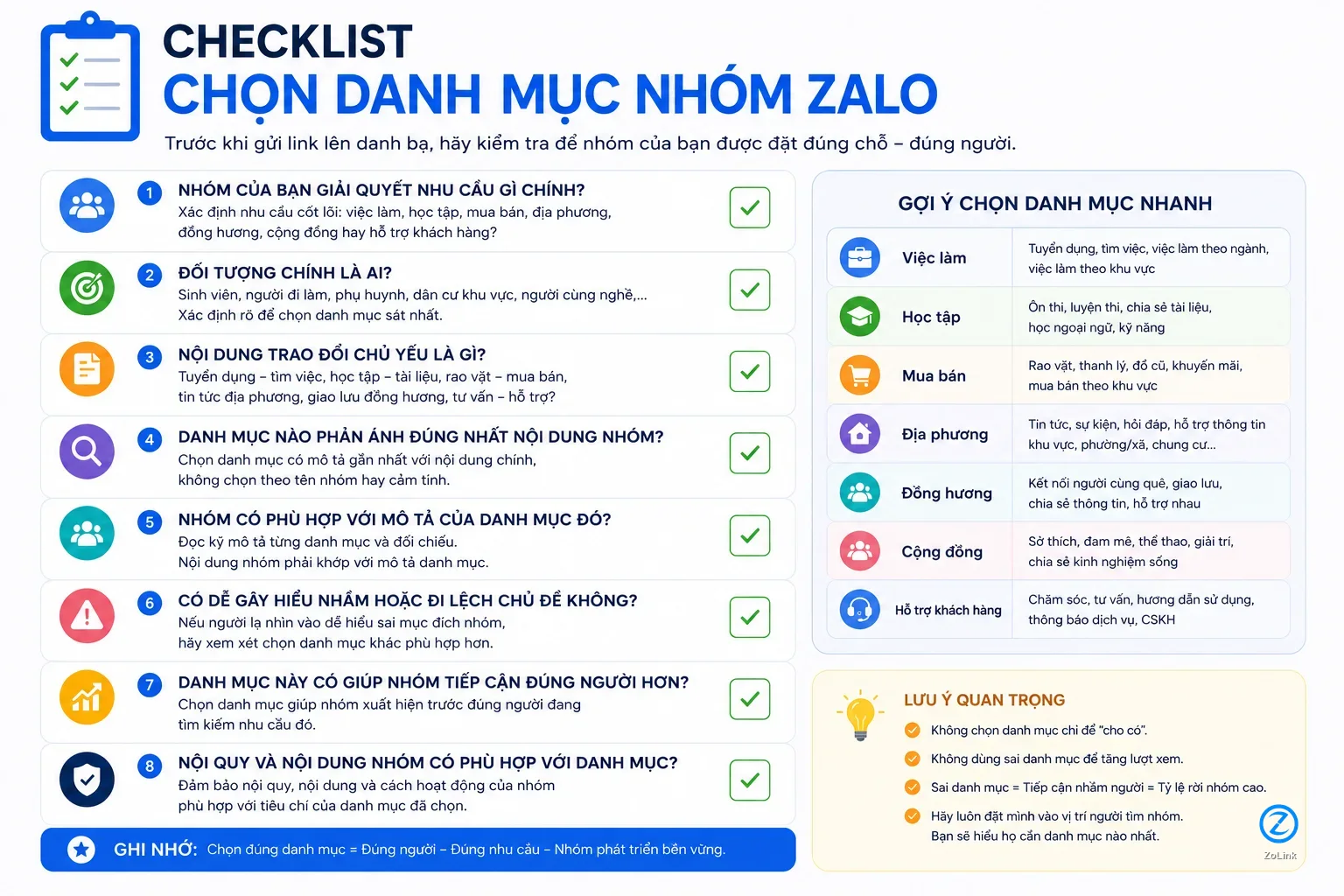
- Do not choose a broad or high-traffic category if it does not match the group’s real content.
- Do not choose based on a few secondary posts; choose based on the main purpose and recurring content.
Checklist before submitting a Zalo group link to a directory
Before submitting a Zalo group link, review four points. First, what main need does the group serve: job search, learning, buying and selling, services, local updates, hometown connection, entertainment, or customer support? Second, who is the ideal member? Third, what content appears most often? Fourth, if a stranger saw the group in the selected category, would they understand the expectation correctly?
You can browse Zalo groups by topic to see how readers explore groups by need. Once you have identified the right category, write a concise description, choose a clear title, and submit the link through Submit link. A group placed in the right category has a better chance of reaching relevant people than a group with a good name but the wrong placement.
- Identify the main need, target audience, and recurring content before choosing a category.
- The right category should be supported by a clear title and an accurate group description.
Conclusion on choosing the right Zalo group category
Choosing the right Zalo group category is not a minor step. It helps the group be understood correctly the first time it appears in front of readers. The closer the category is to the real need of the members, the more likely the group is to attract suitable people, reduce wrong-fit joins, and make community management easier for admins.
The simplest approach is not to ask what the group is called, but why people join it. If they join to find work, choose jobs. If they join to learn, choose learning. If they join to buy or sell products, choose a product or retail category. If they join to hire or provide services, choose services. If they join because they share a location, hometown, or community identity, choose the category that best reflects that connection.
- A category should reflect the main need of the members, not just the name of the group.
- Choosing the right category gives the group clearer context and makes it easier for the right people to find.