Why a short Zalo group link can still be hard to share
Many people assume a Zalo group link only needs to be short. In reality, the issue is not just length, but recognizability. A link like zalo.me/asdfas123 may not look long, but the random characters at the end do not tell the recipient what the group is, who it belongs to, what it is for, or whether it is worth clicking.
For shop owners, teachers, community admins, or anyone who regularly handles customers on Zalo, this small friction point repeats often. You may send the link in a chat, paste it into a post, print it on a flyer, add it to a bio, or give it to a sales assistant to share. If customers see a string of random characters, they may hesitate, ask for clarification, or ignore it.
A hard to remember Zalo group link is not only inconvenient to type again. It can also make the entire communication flow feel less professional. Before recipients even join the group, they are already trying to figure out whether the link is correct, official, and relevant to their needs.
- A short but meaningless link can still be difficult to remember.
- Customers may not know what the group is before clicking.
- Admins are more likely to resend the link or explain it repeatedly.
- Sales messages look less polished when they contain messy character strings.
What problems do hard to remember Zalo group links create
When you send a group link to customers, the goal is not simply to move them into the right group. The real goal is to make that action fast, clear, and low-friction. The harder the link is to understand, the more time recipients need to confirm what it is.
Customers may already be receiving many messages at the same time. A link that looks like a random string can easily appear unimportant. For students or community members, the link may be saved for later. If it does not suggest the group's purpose, they may not remember whether it was for a class, a customer-care group, or a promotion group a few days later.
The problem becomes even clearer when the link is shared offline. For example, a staff member may read it over the phone, a shop owner may print it on packaging, a teacher may put it on a slide, or an event organizer may include it in handouts. Random-looking strings are easy to mistype, skip, or capture only by taking a photo.
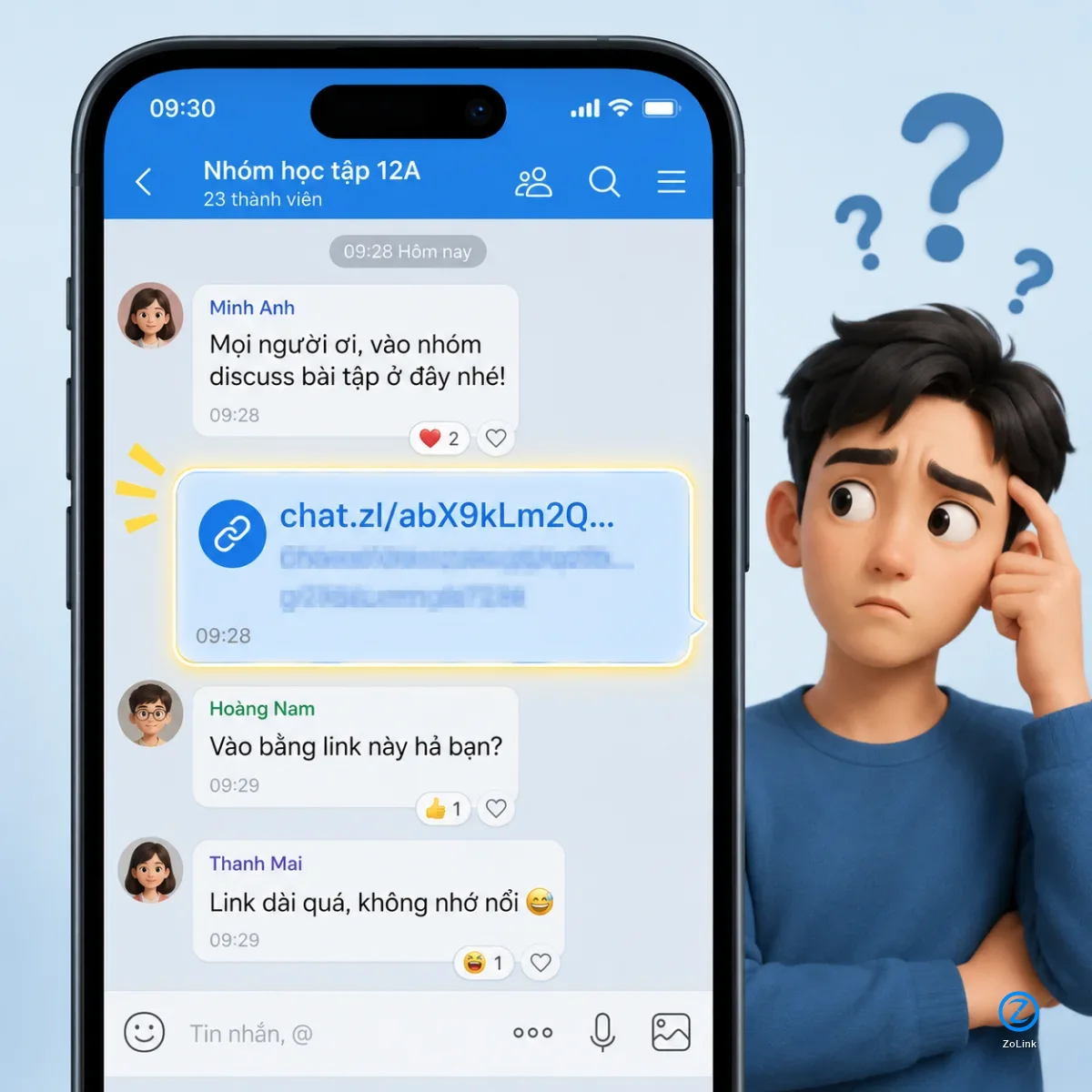
- Customers may ask what the group is for.
- Recipients may not remember the link if they do not click immediately.
- The link is difficult to read when printed, shown on slides, or spoken over the phone.
- It can feel less official in a sales or customer-care context.
Readable links help recipients understand before they click
A readable Zalo group link should answer one simple question at a glance: what is this group about. Instead of sending a link with a random-looking ending, you can use a clearer format such as zolink.vn/shop-thoi-trang or a similar slug that reflects the shop name, category, class, location, or community topic.
The strength of a readable link is that it turns the URL itself into part of the message. When customers see the shop name or group topic in the link, they get an extra signal that they are being invited to the right place. This matters especially for customer-care groups, promotion groups, consultation groups, learning groups, and local communities.
A readable link also makes sharing easier across different channels. The same link can be used in messages, Facebook posts, video descriptions, QR codes, business cards, or sales materials. Recipients may not remember the full URL, but they can quickly recognize what it means.
- The link name should reflect the group's actual content.
- Recipients can understand the context before clicking.
- A meaningful URL helps build trust.
- Readable links work well both online and offline.
How to name a Zalo group link so it is easy to remember
A link name should not be chosen randomly. A good slug is short, readable, accent-free, free of complicated characters, and clear enough for recipients to understand what the group is about. You do not need to pack too much information into the link. Focus on the most important element: the shop name, group topic, product category, location, or joining purpose.
If you run a shop, name the link after your brand or main product category. If you are a teacher, use the class name, subject, or course name. If you manage a community, use the topic or location. The closer the link is to how people naturally refer to the group, the easier it is to remember.
For example, a fashion shop might use a slug such as shop-thoi-trang, vay-cong-so, or sale-thang-5. An English learning group might use lop-tieng-anh-a1 or giao-tiep-cho-nguoi-moi. A resident community could use cu-dan-quan-7 or cho-me-va-be-ha-noi.
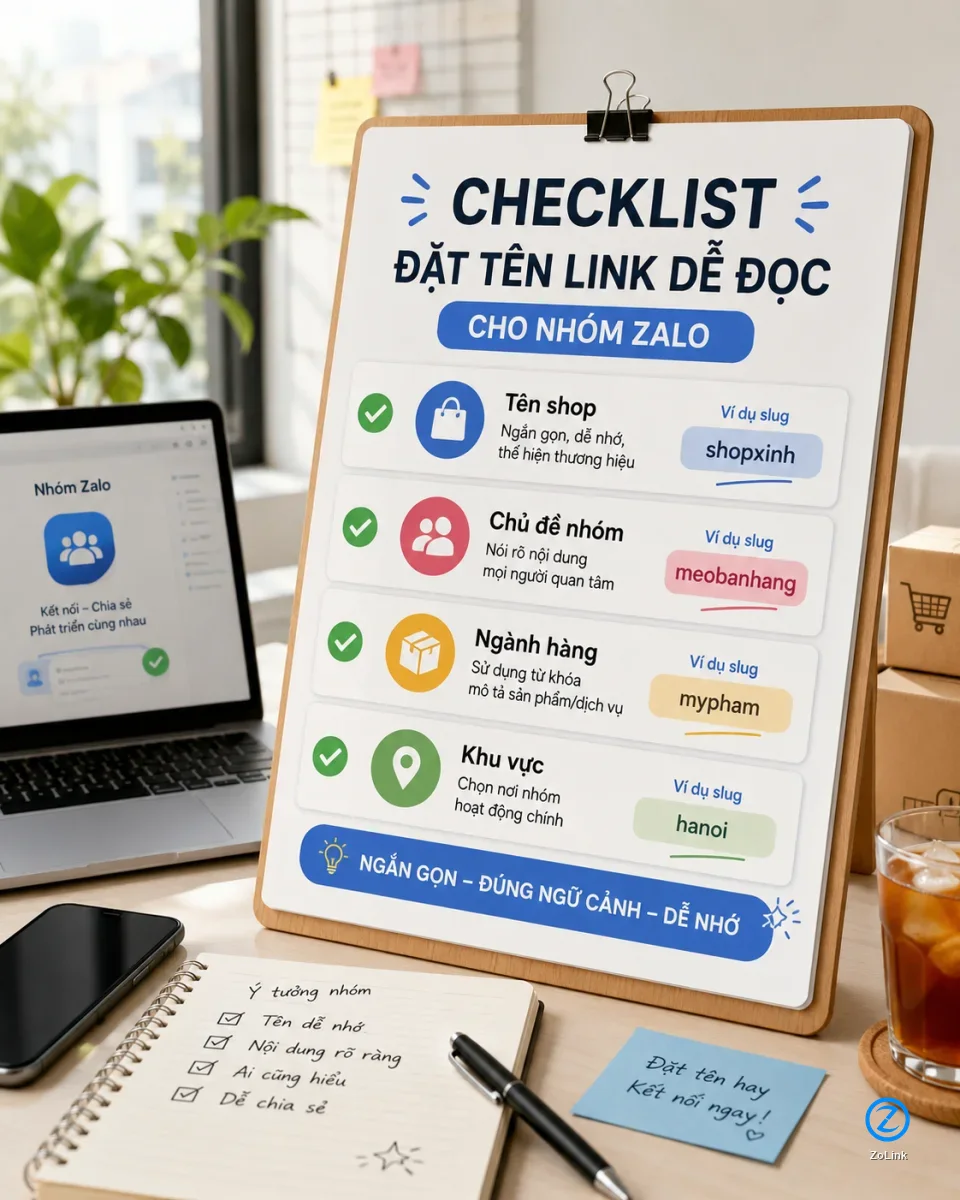
- Use short, common, easy-to-read words.
- Avoid unnecessary numbers unless they have a clear meaning.
- Do not use abbreviations that outsiders will not understand.
- Avoid overly generic slugs such as nhom-moi or zalo-123.
Suggested slug structures for different use cases
For sales groups, the most practical structure is the shop name plus the category or purpose. Examples include ten-shop, ten-shop-sale, ten-shop-khach-vip, or ten-shop-tu-van. This helps customers recognize which shop the group belongs to and why they should join.
For service consultation groups, choose a slug that reflects the customer's actual concern. Examples include tu-van-bao-hiem, tu-van-du-hoc, dich-vu-ke-toan, or thiet-ke-noi-that. When customers receive the link after a consultation, a clear slug connects directly to the need they originally discussed.
For learning or community groups, prioritize the topic and audience. Examples include hoc-excel-co-ban, tieng-anh-giao-tiep, cong-dong-freelancer, or me-va-be-da-nang. These names are easy to read and can also be reused in QR codes, emails, or printed materials.
- Online shops: ten-shop, ten-shop-sale, ten-shop-vip.
- Consulting services: tu-van-nganh-hang or a specific service name.
- Classes: subject-level or course-name format.
- Communities: topic-based or topic-plus-location format.
How to turn a Zalo group link into a cleaner URL
The practical workflow is simple. First, prepare the original Zalo group link. Then choose a readable slug, check whether it makes sense to the recipient, and create a new link for sharing. When you need to submit a link to the system, you can use zolink.vn/gui-link to send the URL for processing.
Once you have a readable link, replace the old one wherever customers usually see it: sales message templates, product descriptions, pinned posts, QR codes, landing pages, staff signatures, and instruction materials. Do not update it in only one place while leaving the random-looking link elsewhere, because that creates an inconsistent customer experience.
If you manage or share many groups by topic, you can browse zolink.vn/nhom-zalo to see how groups and categories can be presented more clearly. ZoLink should be treated as a support point for making links easier to understand, while your group content and member care remain the deciding factors.
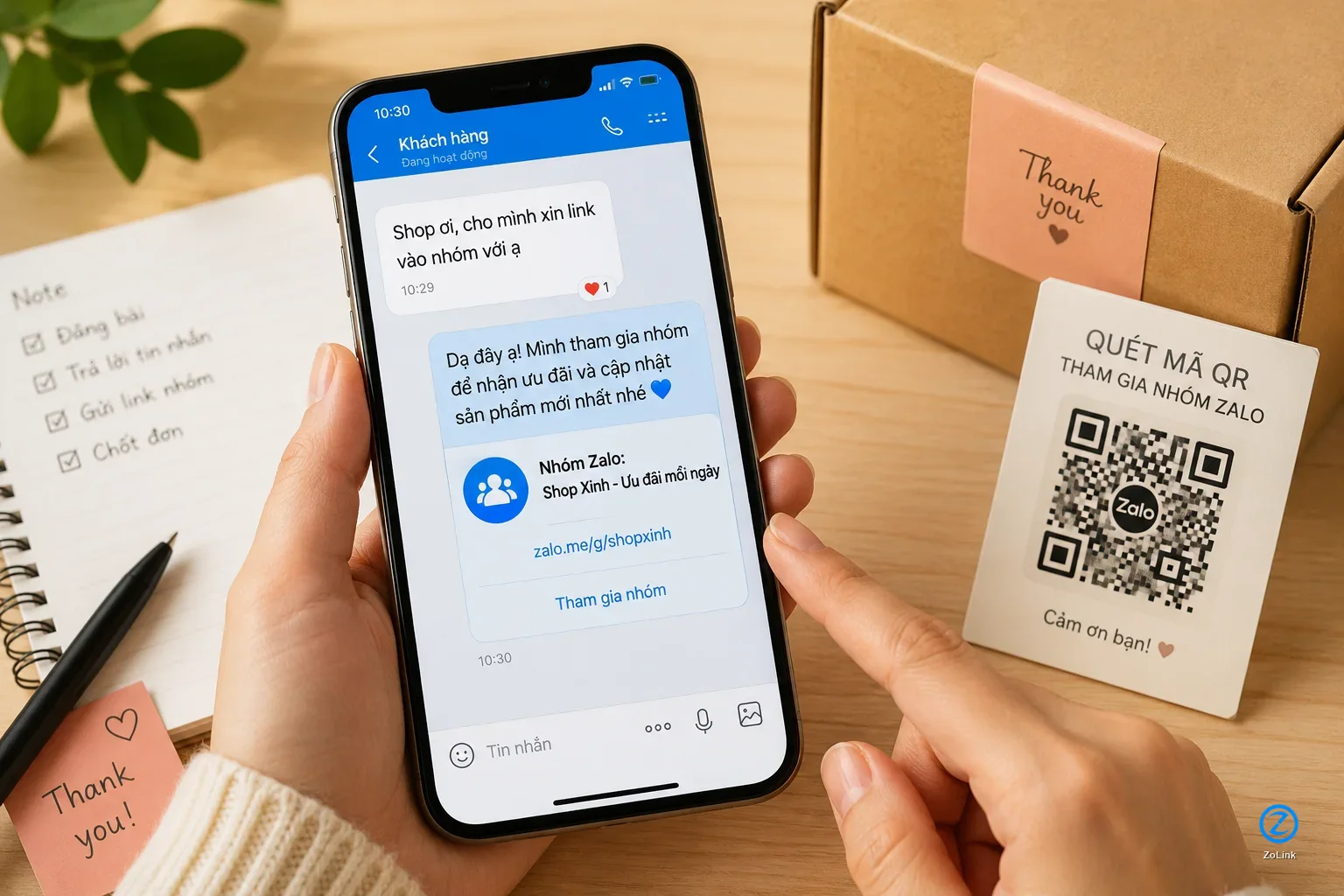
- Prepare the original Zalo group link.
- Choose a short slug that matches the topic and is easy to read.
- Use the new link consistently across customer-facing channels.
- Check the link carefully before printing it, attaching it to a QR code, or sending it in bulk.
When should you use a readable Zalo group link
You should use a readable link whenever the group link is not being sent just once to someone who already knows you. If the link appears in a sales flow, customer-care flow, member recruitment process, student onboarding process, event communication, or community-building activity, switching to a clear URL is worth doing.
For online shops, a readable link makes messages inviting customers to a promotion group look cleaner. For teachers, a meaningful link helps students and parents recognize the right class group. For local communities, a link that includes the topic or location gives newcomers more confidence before joining.
Even if the group is still small, setting up a memorable link early can help. You avoid changing materials later, reduce confusion between multiple groups, and make it easier for existing members to invite new people.
- Loyal customer groups or promotion groups.
- Class groups, course groups, students, and parents.
- Service consultation groups that send links repeatedly every day.
- Communities based on industries, interests, or locations.
Mistakes to avoid when naming a group link
The most common mistake is making the link too long because you want to include every detail in the slug. A URL such as shop-thoi-trang-nu-gia-re-chat-luong-cao-ha-noi may be descriptive, but it is no longer clean. When the slug is too long, it loses the benefits of being easy to remember and easy to read.
The second mistake is choosing a name that is too generic. Slugs such as nhom-zalo, khach-hang, uu-dai, or shop-online are not distinctive enough if you manage several groups. Recipients may also struggle to understand which brand or topic the group belongs to.
The third mistake is using characters or naming styles that create confusion. Unnecessary numbers, internal abbreviations, short-lived campaign names, or mixed writing styles can make the link harder to use over time. If you need official information related to Zalo, you can refer to the Zalo Help Center, while the link name itself should remain clear for end users.
- Do not make the slug too long.
- Do not use an overly generic name if you manage multiple groups.
- Do not use abbreviations only internal staff understand.
- Do not change the link constantly after customers have become familiar with it.
Checklist before sending a Zalo group link to customers
Before using a new link in sales or customer care, read it as if you knew nothing about the group. If the URL alone helps you guess which shop it belongs to, what topic it covers, or why someone should join, the slug is already doing its basic job.
Next, test the link inside a real message. A good message should include a short introduction before the link, such as: I am sending you the group link for the shop's latest offers, or this is the class group where weekly materials will be shared. When the message and the link are both clear, recipients are less likely to ask follow-up questions.
Finally, check consistency. The link in posts, QR codes, bios, message templates, and printed materials should point to the same destination. For important groups, keep a record of the slug you used so you do not create similar variants later.
- Can someone understand the group's purpose by looking at the link.
- Is the slug short and easy to read in a message.
- Does the link work well for QR codes or printed materials.
- Are all sharing channels using the same URL.
Conclusion
A hard to remember Zalo group link may not always stop customers from joining immediately, but it adds friction to the joining process. For anyone who regularly sends links to customers, students, community members, or consultation leads, this small friction point can repeat hundreds of times.
Turning a group link into a readable URL helps recipients understand faster, trust the link more, and remember it better. Start with a short, meaningful slug tied to the shop name, group topic, or joining purpose. When the URL becomes a clear part of the message, sending Zalo group links to customers becomes cleaner and more professional.
- Readable links reduce confusion.
- A meaningful slug makes your communication feel more professional.
- The link name should match the recipient's real need.
- ZoLink can help present group links in a clearer and more understandable way.