Why search for Zalo groups by topic instead of clicking random links?
Many people look for Zalo groups by clicking whatever link they happen to see: in social media posts, comment sections, forwarded messages, or scattered link lists. It feels quick, but it often leads to the wrong group, an inactive group, a space full of ads, or a community whose content no longer matches its name. If your goal is to study, find jobs, shop, ask for local advice, connect with people from your hometown, or join a hobby-based community, searching for Zalo groups by topic is far more effective.
Searching by topic means you start with your real need, then choose a group whose name, description, members, and recent activity match that need. For example, job seekers should look for recruitment groups by industry or location; someone learning English should choose a group with a clear study focus; and someone who has just moved to a new city should prioritize active local groups. This approach cuts through noise and increases your chance of joining the right community.
- Not every group link is still active or accurately described.
- A topic-matched group helps you ask the right people, get relevant answers, and save time.
- Before joining, check the group name, description, recent content, and spam signals.
Start with the real need: what do you want the group for?
Before searching, clarify your purpose. Someone looking for a study group will need different criteria from someone looking for job postings, shopping deals, parenting communities, business groups, or hometown networks. If your need is vague, you may end up joining too many groups without getting real value from any of them. Notifications pile up, messages move too fast, and the information you actually need still gets buried.
A simple way to start is to write your need as a specific sentence: “I want a marketing jobs group in Ho Chi Minh City,” “I want a beginner Japanese learning group,” “I want a local community group in Da Nang,” or “I want an active mother-and-baby buy-and-sell group.” The clearer the need, the better your search terms become, and the easier it is to judge whether a group is worth joining.
You can begin with the Zalo group directory by topic to browse common needs such as study, jobs, communities, shopping, or local groups. If you already have a specific keyword in mind, the Zalo group search page can help you filter faster instead of scrolling through unrelated links.

- The more specific your need is, the more accurate your group search becomes.
- Use both topic and location when the information you need is local.
- Do not join too many groups at once before checking their quality.
How to search for common types of topic-based Zalo groups
For study groups, prioritize names that clearly mention the subject, level, goal, or learner profile. A generic group name like “Daily Learning” may be less useful than one that says “IELTS for Beginners,” “Grade 9 Math,” “Self-study Excel for Office Work,” or “Beginner Korean.” Good study groups usually include learning materials, real questions, regular discussion, and minimal off-topic advertising.
For job groups, search by industry, location, or work format. Examples include part-time jobs in Hanoi, accounting recruitment, tech jobs, remote jobs, or marketing internships. If you join a job group that is too broad, postings move quickly and many will not fit your profile. Job seekers should also read the group rules carefully and be cautious with posts that ask for fees, deposits, or personal information too early.
For shopping, fashion, parenting, or business groups, moderation and transparency matter most. A good group should have posting rules, a way to handle disputes, clear seller information, and content that is not drowned out by repetitive spam. For local or hometown groups, check whether the group is tied to the right area, still has real interaction, and shares content that genuinely serves the community.
- Study groups: look for a clear subject, level, goal, or material-sharing purpose.
- Job groups: look for a clear industry, location, work format, and posting rules.
- Shopping or business groups: prioritize moderation, transparency, and low spam.
Checklist for choosing the right group before joining
A suitable Zalo group usually has four basic signals: a clear name, an accurate description, recent activity, and content that still matches the original topic. The name should tell you who the group is for and what it is about. The description should explain the purpose, rules, content scope, or location. If the group name says it is about learning but the recent messages are mostly sales posts, that is a sign the group has drifted away from its original purpose.
Activity level matters too. A large group whose last message was months ago may not be useful anymore. On the other hand, a smaller group with real discussion, relevant questions, and active moderation can be much more valuable. When choosing a suitable Zalo group, do not focus only on member count. Ask whether the group still solves the problem you came for.
You should also look at how the group handles off-topic content. Groups where admins remind members, pin announcements, remove spam, or guide people to post in the right format are usually more reliable than groups where anything goes. For sensitive categories such as jobs, finance, buying and selling, or collaborator recruitment, moderation becomes even more important.
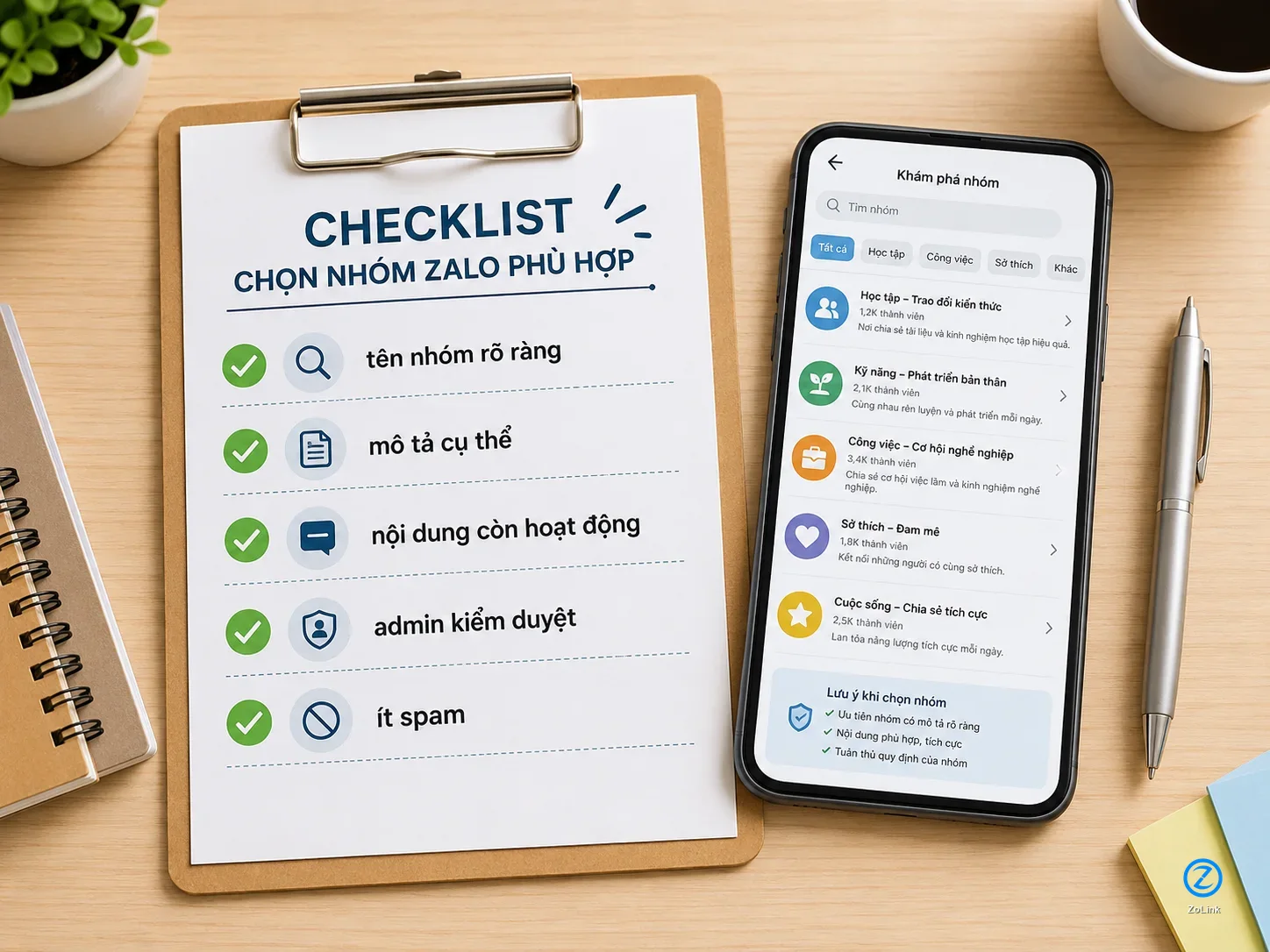
- The group name should clearly show the topic, location, or intended members.
- The description should include the purpose, rules, and content scope.
- Recent content should still be active and not overwhelmed by spam.
- Admins should show signs of management, pinned notices, or off-topic control.
Do not ignore location and community context
The same topic can look very different depending on location. A jobs group in Hanoi is not the same as a jobs group in Binh Duong; a shopping group in Ho Chi Minh City differs from a secondhand group in Da Nang; and a Vietnamese community group in Japan is not the same as one in South Korea. If your need depends on place, combine the topic with a location in your search.
For example, instead of searching only for “Zalo job groups,” try “Da Nang Zalo job group” or “Binh Duong industrial park jobs Zalo group.” Instead of searching only for “mother and baby Zalo group,” try “Hanoi mother and baby Zalo group” if you need to buy and sell, ask about clinics, find classes, or exchange local experience. For Vietnamese people living overseas, keywords by country, city, or hometown community will help narrow the results.
If you are interested in groups for a specific area, you can also read the guide on finding local Zalo groups near you to choose the right province, city, or community and avoid groups that are too broad.
- Combine the topic with a province, district, country, city, or community name.
- Local groups work better when you need nearby jobs, shopping, events, or support.
- For Vietnamese communities abroad, search by country, city, or hometown network.
Signs that a Zalo group is not worth joining
Some groups have attractive names, but the content inside is not trustworthy. The first warning sign is a vague description that does not explain who the group is for, what topic it covers, or what rules members should follow. The second sign is too many suspicious links, repeated posts, unrelated ads, or invitations to other channels. If you enter a group and immediately see a wall of spam, leaving early is usually the best move.
More serious red flags include requests for personal information, bank transfers, deposits, strange file downloads, or shortened links with unclear destinations. In job groups, be cautious with posts promising unusually high income while giving vague job details. In shopping groups, be careful with sellers who provide little information. In study groups, avoid questionable files, course promotions, or download links from unknown sources.
A group can also become less useful over time. It may once have been good, but if the newest content no longer matches the group name, admins are no longer active, or members keep complaining about spam, it is a sign you should look for a better group.
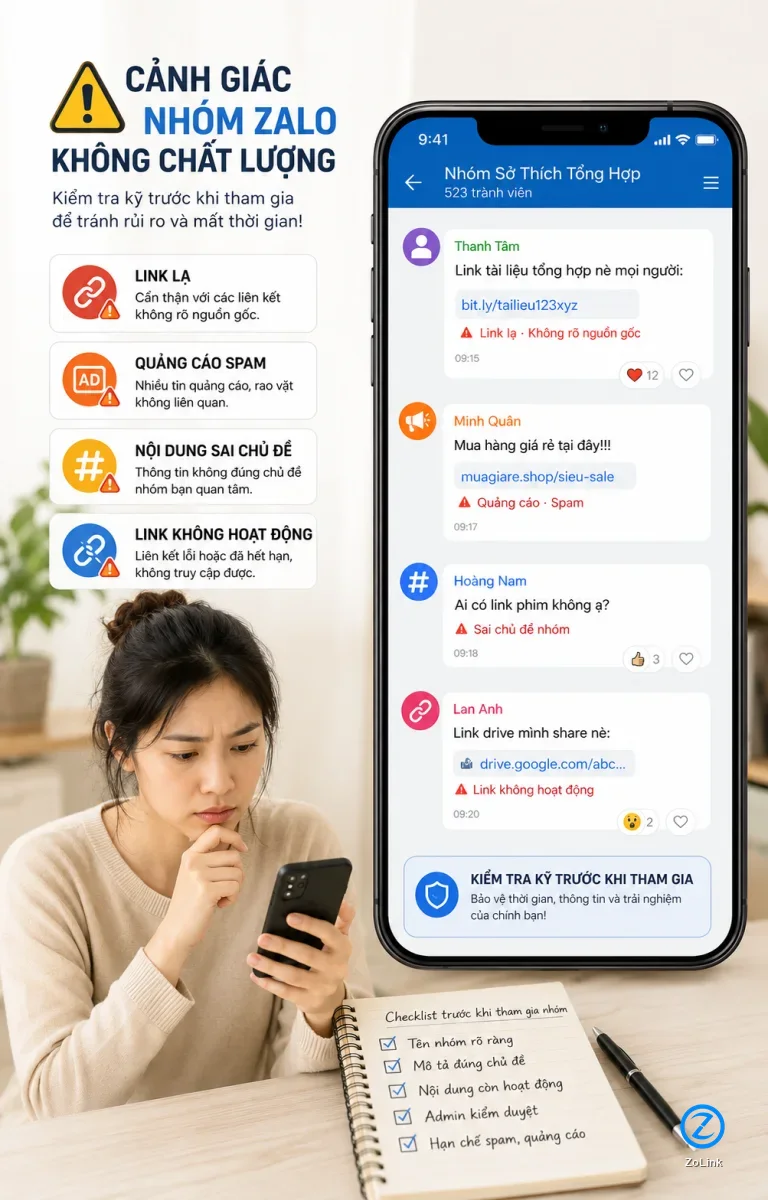
- The group description is vague, has no rules, or does not clearly state the topic.
- There are many suspicious links, spam messages, repeated ads, or sensational posts.
- The group asks for deposits, transfers, strange file downloads, or personal data too early.
- The group name says one thing, but the actual content is about something else.
How to join groups smartly without getting overwhelmed
After finding a few promising groups, avoid joining everything and letting notifications run nonstop. Choose one to three of the best groups for each need. During the first few days, observe whether the group is actually useful: do people answer questions, does the content stay on topic, do admins moderate, and do members interact respectfully?
You can mute secondary groups, pin important ones, or save posts you want to review later. If a group no longer fits your needs, leave it instead of keeping too many unused communities. This keeps your Zalo cleaner, improves the quality of information you receive, and reduces the chance of getting pulled into unnecessary conversations.
If you manage a group, use a clear group name, write a complete description, and keep the content aligned with the topic. A well-managed group helps current members communicate better and helps new members quickly decide whether the group is right for them. When you want your group to reach the right audience, you can submit the link so it can be categorized and displayed more appropriately on ZoLink.
- Keep only the groups that genuinely serve your current needs.
- Observe a group for a few days before treating it as a main information source.
- Mute or leave groups when the content is no longer relevant.
- Admins should manage the group name, description, and rules so new members can evaluate it easily.